
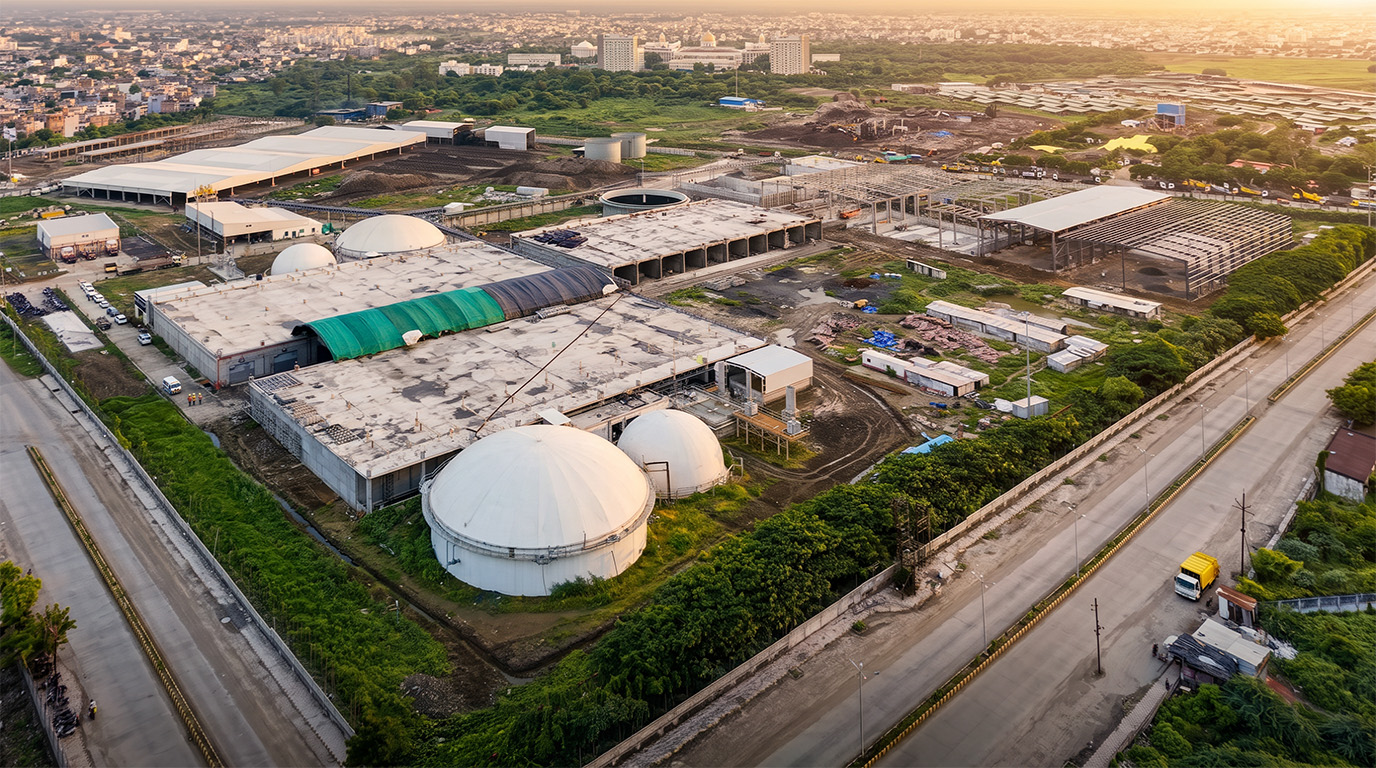
The 12-hectare site combines sorting, fermentation, gas upgrading and composting in one integrated facility.
Designed to process up to 1,200 tonnes of mixed municipal solid waste per day, separating organic material for renewable energy production and recovering valuable resources.
Thirty sealed fermentation tunnels process the organic waste in batches, producing biogas around the clock.
Biogas is purified and upgraded using membrane technology before being compressed into renewable CBG for distribution.

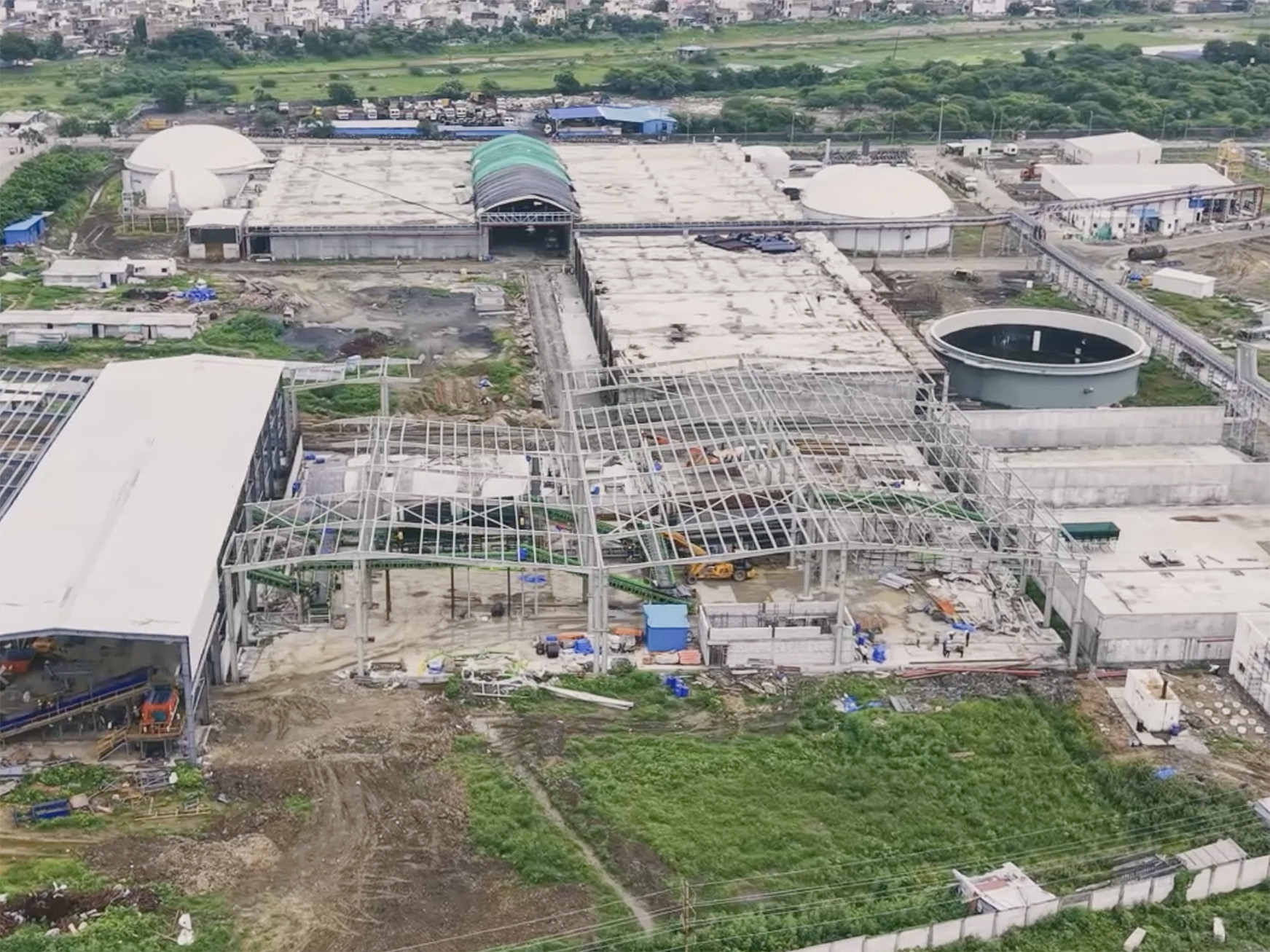
Explore the complete process: from receiving municipal solid waste and recovering the organic fraction to producing renewable gas and see how phased commissioning enables gas production while remaining sections are being completed.
The Bhandewadi facility operates under a long-term concession framework with Nagpur Municipal Corporation (NMC). It is designed to process up to 1,200 tonnes of mixed municipal solid waste daily, integrating sorting, anaerobic digestion, renewable gas production and the recovery of secondary materials.
Nagpur illustrates SusBDe's integrated project concept and how it can be delivered through dedicated local project execution, international engineering, specialist technology partners and arrangements for insurance and carbon credits.
Nagpur Integrated MSW-to-CBG Facility
Bhandewadi, Nagpur, Maharashtra, India
Nagpur Municipal Corporation (NMC)
SusBDe LOC Nagpur Private Limited
Keva Fragrances Private Limited
Keva SusBDe Biotech Private Limited
SusBDe Royalties Ltd.
Machinefabriek Emmen (MFE), Netherlands
Waste Treatment Technologies (WTT), Netherland
Thermax Limited, India
SusBDe Carbon Credits Ltd.
SusBDe Royalties Ltd.
Keva Constructions Private Limited
15 + 15 years
Maharashtra Pollution Control Board (MPCB)
24 May 2026
Approximately 12 hectares
Up to 1,200 tonnes per day (design)
Mixed municipal solid waste (MSW)
Segregation, dry anaerobic fermentation and gas upgrading
30 sealed concrete fermentation tunnels in three sections
Drying, desulphurisation and membrane upgrading
Compressed Bio Gas (CBG)
Approximately 55 tonnes/day – Full Design Capacity
Up to 2,070 m³/hour (approximately 35.6 tonnes/day equivalent)
Approximately 28 tonnes/day (October 2026)
Up to 115 tonnes/day under amended consent
Up to 425 tonnes/day under amended consent
Up to 10 tonnes/day under amended consent
Two fermentation sections operational; third section under construction as of October 2026

The Nagpur project brings together a long-term municipal framework, an Indian project promoter and operator, engineering inputs from the Netherlands and India, specialised treatment technology, and arrangements for insurance and carbon credit development.
Structural and engineering contributions include Geelhoed Engineering in the Netherlands and PRIVIJ Consultants Engineering in India. This combination of international know-how and Indian engineering and execution capacity is integral to a replicable project approach.
Nagpur demonstrates how SusBDe's integrated Ready-to-Operate approach brings together project development, specialised technologies, engineering, local execution and long-term operational support within a replicable project model.

Nagpur represents more than a single renewable energy facility. Its phased development illustrates how large-scale waste-to-resource projects can progress from project design and commissioning to commercial production while retaining a repeatable integrated structure.
The experience gained provides a reference for further municipal waste-to-CBG developments in India and for potential application in other international markets.

Discover how SusBDe's integrated Ready-to-Operate solutions can help municipalities, project developers and investors transform waste into renewable energy and valuable resources.
Explore Your Project with SusBDe and contact Mr. Jaap Veenenbos at j.veenenbos@susbde.com


In Nagpur, Maharashtra, a major milestone in the development of SusBDe's integrated waste-to-energy concept has been achieved. Initiated in 2021 and developed through close cooperation between Indian and Dutch partners, the project demonstrates how large-scale municipal waste treatment, renewable gas production and resource recovery can be combined within one integrated facility.

Commencing April 14th, 2024, Savoie Senegal and SusBDe join forces to confront Senegal's waste management issues and foster clean energy production for the region. Leveraging organic waste sourced from municipal collections by local partners, the initiative aims to effect positive change and cultivate renewable energy solutions.

Our adaptable French blueprint not only provides a compelling template for future growth but also represents the initial milestone for achieving an efficient time-to-market in the biogas production industry, allowing you to progress from inception to full commercial operation within 18-24 months.

Central U.P. Gas Limited (Central Uttar Pradesh Gas Limited) and SusBDe are collaborating to develop joint projects in the state of Uttar Pradesh and beyond.

